
Talking Machines
The adventure of recorded sound
For centuries, humanity dreamed of capturing the human voice.In 1877, that dream became reality, 1877marking the beginning of a sound revolution.
A coveted invention: Charles Cros vs. Thomas Edison
The April 30, 1877,the French inventor Charles Cros presented a paper to the Academy of Sciences describing the principle of sound recording..
But nine months later, Thomas Edison filed a similar patent in the United States. His invention was officially recognized, allowing him to build the first true phonograph..
Thus began the era of talking machines,fascinating, innovative, and immensely popular. For the first time, the human voice could be reproduced, something mechanical musical instruments had never been able to achieve.
An exceptional collection of phonographs and gramophones
The Talking Machines Room displays more than 200 period devices,from the most rudimentary to the most sophisticated:
- Wax-cylinder phonographs powered by weights, hand cranks, or springs
- Spring-driven disc gramophones (wound with a crank or key)
- Iconic jukeboxes from the 1950s and 1960s
Each machine is presented within its historical context,illustrating the evolution of recording media, mechanisms, and sound reproduction.
An educational presentation
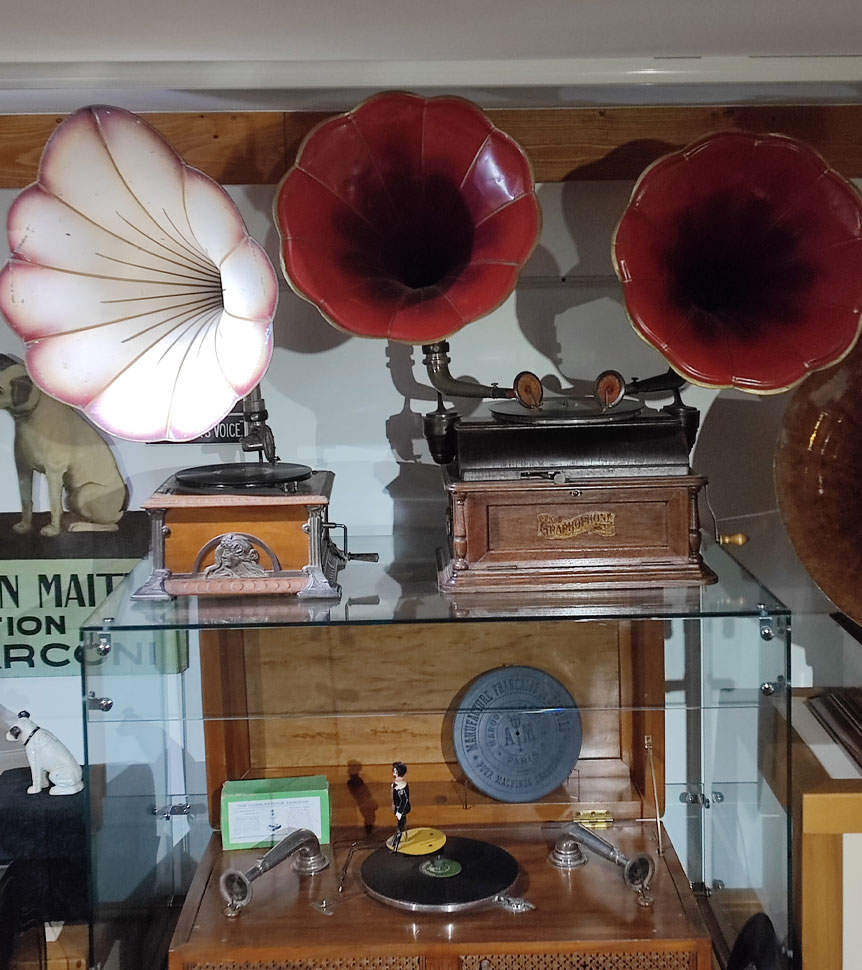
A carefully designed exhibition and an explanatory film accompany the visit, helping visitors better understand the technical, cultural, and social history of these remarkable machines.
Discover how they revolutionized music listening in the early 20th century by bringing recorded music into homes around the world.